
Syllable Counter
0
Syllables
0
Words
0
Characters
0
Lines
0
Sentences
0
Paragraphs
0
Reading Time (min)
0
Speaking Time (min)
Introducing Our Syllable Counter Tool
Our syllable counter tool is fast, reliable, and user-friendly, making it perfect for a range of tasks—from poetry to speechwriting.
How to Use Our Syllable Counter Tool?
Using our syllable counter is simple:
- Enter the Word or Text: Type or paste your text into the input box.
- Example Walkthrough: If you enter “beautiful”.

- Get Your Result: There is no button to press. As soon as you type, the eight boxes above update automatically and show the number of syllables, words, characters, lines, sentences and paragraphs, plus the estimated reading time and speaking time.
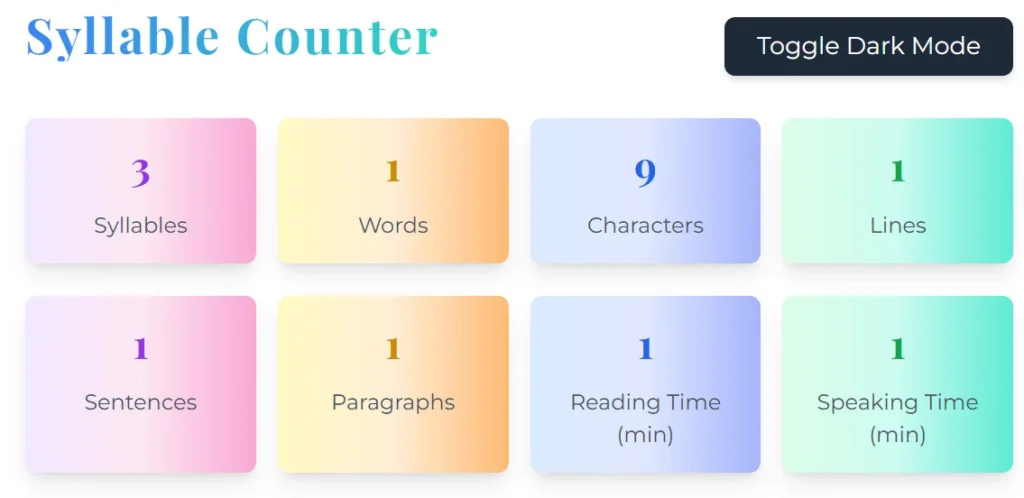
- Finally: For the word “beautiful”, our syllable counter shows 3 syllables (beau-ti-ful).
Features of Our Syllable Counter Tool
What Are Syllables?
To use a syllable counter tool effectively, it’s essential to first understand the concept of a syllable.
Definition and Explanation of Syllables
A syllable is a single, uninterrupted sound within a word, typically featuring a vowel sound, with or without surrounding consonants, to form a unit of pronunciation.
For instance, the word “apple” contains two syllables: “ap-ple.” Syllables are fundamental to both written and spoken language, shaping pronunciation and rhythm.
English Syllable Structure:
Syllables in English generally follow a consonant-vowel structure, such as:
- CVC (Consonant-Vowel-Consonant): “cat”
- CV: “me”
- CCV: “three”
The structure can vary, impacting word sounds and influencing sentence rhythm.
10 Examples of Syllable Words
Here are examples of number of syllables in a word, which are helpful when using a syllable counter:
| Word | Syllables |
| Apple | 2 |
| Banana | 3 |
| Chocolate | 3 |
| Elephant | 3 |
| Understanding | 5 |
| Watermelon | 4 |
| Butterfly | 3 |
| Beautiful | 3 |
| Interesting | 4 |
| Computer | 3 |
Understanding syllable structures is valuable for many language-based tasks, from writing poetry to crafting speeches.
How Does a Syllable Counter Work?
A word syllable counter automates syllable counting by analyzing the phonetic structure of words. It typically identifies vowel sounds and syllable patterns, using advanced algorithms for accuracy.
Breaking Down the Technology
Syllable counters detect vowel sequences or clusters, which usually represent syllables in English. Good counters also handle common exceptions, such as a silent “e” at the end of a word, to improve accuracy.
Benefits of Using a Syllable Counter
Using a syllable counter tool offers several advantages beyond simple counting:
Accuracy and Efficiency
A syllable counter provides quick, accurate results, saving time and ensuring precision.
Enhanced Rhythm in Writing
For poems, haiku and song lyrics, a syllable counting tool helps maintain proper rhythm, which depends on consistent syllable structures.
Language Learning Aid
For learners, syllable counters break words into syllables, improving pronunciation.
A Brief History of Syllable Counting
Counting syllables has long been central to linguistics, especially in poetry and education.
Syllables in Ancient Languages
From Greek poetry to Japanese haikus, syllable counts have defined the rhythm and emotion in language.
Modern Developments in Syllable Counting Tools
Today’s digital syllable counters automate the counting process, making it accessible to writers, educators, and students alike.
Types of Syllable Counters
Different types of syllable counters meet a variety of needs. The most common types include:
Online Syllable Counters:
Web-based tools offering quick syllable counts without the need for downloads.
Syllable Counting Apps:
Mobile apps provide syllable counting on the go, often with additional tools like readability scores.
Built-in Syllable Counters in Writing Tools:
Some software includes a syllable counter feature to monitor syllables during the writing process.
Conclusion
A syllable counter is invaluable for writers, teachers, and language learners. It ensures quick, accurate syllable counts, allowing you to focus on creativity rather than technicalities. Our tool combines accuracy with ease of use, making it a go-to for anyone working with language.